Trico (Tricorythodes)
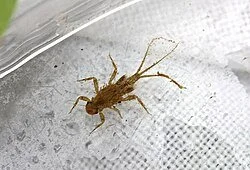
Latin: Tricorythodes spp. — most commonly T. minutus and T. explicatus Family: Leptohyphidae Sizes: #20 – #24 Where: North American spring creeks, tailwaters, and freestones with fertile water
Overview
The Trico is one of the smallest hatchable mayflies — a black-bodied, white-winged miniature whose summer-morning emergence and spinner fall draw trout to the surface in clouds of feeding fish. Adults are 4–6 mm long, with the spinner stage (after molting) being the form most heavily fished. Tricos are most active in mid-to-late summer when other hatches are fading; they keep the dry-fly game alive into August and September.
Life cycle and angler relevance
The Trico cycle is unusual — adults emerge at first light, molt into spinners almost immediately, mate, and fall back to the water all within a few hours of dawn. Anglers who time it right (typically 8–11 AM) can hit a "spinner blanket" — thousands of dead spinners on the surface, with rising fish keyed in. The fishing is technical: long fine tippets, clean drifts, tiny patterns.
Imitating patterns
Spinners: Trico Spinner (CDC or hackle wing), generic small black-and-white mayfly spinners, CDC Para Spinner. Duns: tiny Parachute Adams in size 22, generic small dark mayfly. Nymphs: tiny Pheasant Tail Nymph and tiny perdigons in #18–22.
References
- Wikipedia: Tricorythodes
- Mentioned in 2025 Kingfisher Blackfoot August reports and several Missouri River reports
- Field photos by Michael Shoop (CC-BY-NC) via iNaturalist

Field photo 1 (Rio Grande, NM)

Field photo 2 (Rio Grande, NM)