Gray Drake
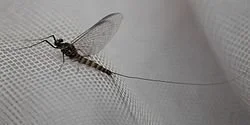
Latin: Siphlonurus occidentalis Family: Siphlonuridae Sizes: #10 – #14 Where: Western North America — productive on slower Western streams and tail-water sections
Overview
The Gray Drake is a large, slate-gray mayfly that overlaps with the Western Green Drake but is more often fished as a spinner than a dun. Unlike most mayflies whose dun phase gets the dry-fly attention, gray drake duns are typically dropped into vegetation and never make it back to the water — meaning the spinner fall in the evening is when fish get keyed on them. The body is purple-gray and the spent wings sit out flat on the water, making them tough to spot but extremely productive when fish are tuned in.
Life cycle and angler relevance
Nymphs are agile swimmers that live in slow water with vegetation. Adults emerge but most fly directly to streamside foliage to molt, returning at evening as spinners. The spinner fall typically begins as the sun drops behind the ridges. Best windows: late June through July, evening (7–10 PM), on calmer reaches and slow tailouts.
Imitating patterns
Spinners: Gray Drake Spinner (purple-gray body, hackle-tip or CDC wing), generic large mayfly spinner patterns. Duns (less commonly fished): generic gray-bodied mayfly dries in size 10–12. Nymphs: large Pheasant Tail variants.
References
- Wikipedia: Siphlonurus
- Mentioned in 2026 Missoula area fishing reports
- Field photos by Michael Long (CC-BY-NC) via iNaturalist

Field photo 1 (Garfield County, UT)

Field photo 2 (Garfield County, UT)